
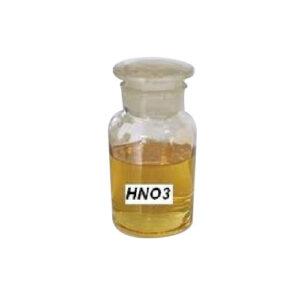
NITRIC ACID
In Stock
Highlights:
Nitric Acid (HNO₃)
Industrial Grade Nitric Acid 68-70% – Premium Chemical Oxidizing Agent
Nitric acid (HNO₃) is a highly versatile and powerful oxidizing agent extensively utilized in fertilizer manufacturing, metal processing, electronics industry, chemical synthesis, and industrial cleaning applications. Our industrial-grade nitric acid delivers exceptional oxidizing performance with consistent concentration and high purity for demanding chemical processing applications.
✅ 68-70% Industrial Grade Concentration – Superior Oxidizing Performance
✅ Clear Colorless Liquid – Highly Corrosive & Reactive Properties
✅ Technical, ACS & Electronic Grades Available
✅ CAS 7697-37-2 Certified – Laboratory & Industrial Standards
✅ Used in Fertilizer Production, Metal Treatment, Electronics, Chemical Manufacturing
Description
Nitric Acid for Industrial & Chemical Processing Applications
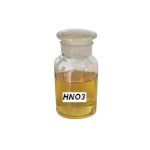
Nitric acid (HNO₃) presents as a clear, colorless to pale yellow liquid with exceptional oxidizing properties, serving critical functions across fertilizer manufacturing, metal processing, electronics production, chemical synthesis, and industrial applications. By far the principal use of nitric acid (80%) is in the manufacture of fertilizers. Of this 96% is used to make ammonium nitrate and calcium ammonium nitrate. HNO₃ is a common laboratory reagent and an important industrial chemical in manufacturing fertilizers and explosives.
At Chemicals & Process Equipment Limited, we supply industrial-grade Nitric Acid (68-70% concentration) manufactured under stringent quality control standards and international specifications. Our product portfolio includes technical, ACS reagent, and electronic grades meeting diverse requirements for fertilizer production, metal treatment, electronics manufacturing, and chemical processing across global markets.
✅ Industrial Grade Standards – Multi-Concentration Options Available
✅ Technical Quality Control – Laboratory & Manufacturing Applications
✅ Electronic Grade Certification – High-Purity Semiconductor Applications
✅ Multi-Application Platform – Versatile Chemical Processing Performance
✅ Complete Documentation – Comprehensive Quality Assurance Package
For comprehensive information on nitric acid applications in chemical processing, refer to this detailed nitric acid industrial guide by Essential Chemical Industry. Our oxidizing agents portfolio provides specialized guidance for optimal chemical processing performance.
Technical Specifications & Chemical Properties
| Property | Technical Grade | ACS Grade | Electronic Grade |
|---|---|---|---|
| Chemical Formula | HNO₃ | HNO₃ | HNO₃ |
| CAS Number | 7697-37-2 | 7697-37-2 | 7697-37-2 |
| Molecular Weight | 63.01 g/mol | 63.01 g/mol | 63.01 g/mol |
| Appearance | Clear colorless liquid | Clear colorless liquid | Clear colorless liquid |
| Concentration | 68-70% | 69-71% | ≥99.999% |
| Specific Gravity | 1.40-1.42 | 1.41-1.42 | 1.50-1.52 |
| Boiling Point | 83°C (68%) | 121°C (69%) | 83°C |
| Freezing Point | -41°C | -42°C | -42°C |
| pH | <1 (highly acidic) | <1 (highly acidic) | <1 (highly acidic) |
| Oxidizing Power | Strong | Strong | Ultra-Strong |
| Impurities | <2% | <1% | <0.001% |
| Chloride (Cl⁻) | <200 ppm | <50 ppm | <1 ppm |
| Sulfate (SO₄²⁻) | <100 ppm | <20 ppm | <0.5 ppm |
| Heavy Metals | <50 ppm | <10 ppm | <0.1 ppm |
| Packaging Options | 25L jerrycans, 200L drums, 1000L IBCs |
Specialized Packaging Solutions:
- 25L HDPE jerrycans with chemical-resistant seals
- 200L polyethylene-lined steel drums
- 1000L intermediate bulk containers (IBCs) with corrosion-resistant linings
- Laboratory packaging from 500mL to 5L containers
- Custom industrial packaging solutions
Fertilizer Manufacturing Applications
Ammonium Nitrate Production Ammonium nitrate fertilizer is produced by oxidizing ammonia to nitric acid and then neutralizing the nitric acid with additional ammonia. On industrial scale, ammonium nitrate (NH₄NO₃) is used in explosives and fertilizers production. Nitric acid serves as the primary raw material for ammonium nitrate manufacture, providing the essential oxidizing component.
Calcium Ammonium Nitrate Manufacturing 96% is used to make ammonium nitrate and calcium ammonium nitrate. Nitric acid enables the production of calcium ammonium nitrate (CAN), a widely used nitrogen fertilizer providing both immediate and controlled-release nitrogen nutrition for agricultural applications.
High-Nitrogen Fertilizer Production It is highly soluble in water and hygroscopic as a solid, but does not form hydrates. It is predominantly used in agriculture as a high-nitrogen fertilizer. The high solubility and nitrogen content make ammonium nitrate produced from nitric acid ideal for agricultural fertilization programs.
Fertilizer Industry Applications Nitric acid has a wide range of industrial applications, although it’s primarily used in the manufacture of fertilisers as a precursor to ammonium nitrate. In fact, fertiliser production accounts for around 80% of the total global use of nitric acid. This demonstrates the critical role of nitric acid in global agricultural productivity.
Metal Processing & Treatment Applications
Metal Etching & Surface Treatment Technical grade Nitric Acid 25% for metal etching, surface treatment, industrial cleaning, and chemical manufacturing. Reliable oxidizing agent with 1.2 specific gravity. Nitric acid provides excellent metal etching capabilities for precision manufacturing and surface preparation applications.
Stainless Steel Manufacturing Manufacturers use nitric acid to produce ammonium nitrate and calcium ammonium nitrate, commonly used in fertilizers and manufacturing stainless steel. Nitric acid plays a crucial role in stainless steel production through passivation processes and surface treatment applications.
Metal Cleaning & Passivation Nitric acid effectively removes oxide scales, rust, and contaminants from metal surfaces while creating protective passive layers on stainless steel and other alloys, enhancing corrosion resistance and surface quality.
Precision Metal Processing High-concentration nitric acid enables precision metal processing applications including microelectronics fabrication, jewelry manufacturing, and specialized metal component production requiring controlled etching and surface modification.
Electronics & Semiconductor Applications
Electronic Grade Purity Standards Electronic grade nitric acid is a highly pure form of nitric acid used in the electronics industry for cleaning and etching silicon wafers and other electronic components. It is produced through a multi-stage distillation process to achieve a purity level of 99.999% or higher.
Semiconductor Manufacturing The electronic grade nitric acid market is expanding due to surging demand from the semiconductor and electronics sectors, requiring ultra-pure chemicals. EPA regulations and a record $80 billion in U.S. semiconductor investments in 2023 have driven this trend. Electronic-grade nitric acid enables critical semiconductor fabrication processes.
Silicon Wafer Processing Electronic-grade nitric acid provides essential cleaning and etching capabilities for silicon wafer production, removing contaminants and creating precise surface features required for microelectronics manufacturing.
LCD Panel & Solar Applications Electronic Grade Nitric Acid by Application (Semiconductor, Solar Energy, LCD Panel, Others), by Types (EL Grade, VL Grade, UL Grade, SL Grade) demonstrates the diverse electronics applications requiring specialized nitric acid grades.
Chemical Manufacturing & Synthesis Applications
Polymer Industry Applications Some nitric acid is used to make intermediates in the polymer industry, notably in the manufacture of hexanedioic acid (adipic acid) to make polyamides and TDI (toluene diisocyanate or methylbenzene diisocyanate) and dinitrobenzene two of a range of reagents used to make polyurethanes.
Explosives Manufacturing Nitric acid’s properties make it indispensable in numerous applications across various fields. Some of its significant uses include: Explosives Manufacture: It is a key ingredient in producing explosives like TNT (trinitrotoluene), nitroglycerin, picric acid, and dynamite.
Dye & Pigment Production Nitrobenzene is used to make aniline which is a key reagent for making dyes. Nitric acid enables the production of nitrobenzene and other aromatic compounds essential for dye manufacturing.
Chemical Intermediate Production Nitric acid serves as a versatile oxidizing agent for producing various chemical intermediates including organic acids, nitro compounds, and specialty chemicals used across diverse industrial applications.
Laboratory & Analytical Applications
ACS Reagent Grade Standards High-purity ACS grade nitric acid for laboratory analysis, metal etching, and chemical synthesis. Features low particle content for precise analytical applications. ACS-grade nitric acid ensures reliable analytical results in laboratory applications.
Analytical Chemistry Applications Laboratory-grade nitric acid provides essential functionality for sample preparation, metal analysis, trace element determination, and quality control testing across various analytical procedures.
Research & Development High-purity nitric acid enables advanced research applications including materials science, chemical synthesis development, and specialized analytical method development requiring consistent chemical properties.
Educational & Training Applications Laboratory-grade nitric acid serves educational institutions for chemistry instruction, demonstrating oxidation reactions, acid-base chemistry, and analytical procedures in controlled academic environments.
Industrial Processing Applications
Industrial Cleaning Applications This acid solution is specifically designed to cater to the rigorous demands of industrial, laboratory, and professional hobbyist projects. Industrial Grade Power: Average of 67% concentration. Industrial-grade nitric acid provides powerful cleaning capabilities for equipment maintenance and process cleaning.
Uranium Processing Nitric acid is a fertilizer raw material and is also used in many other industrial and chemical applications, including nylon 6,6, metal treatment and uranium processing. Nitric acid enables uranium extraction and purification processes in nuclear industry applications.
Titanium Ore Treatment It is also used for the treatment of titanium ores. Nitric acid facilitates titanium dioxide production through ore processing and purification procedures.
Nylon Production Nitric acid is a fertilizer raw material and is also used in many other industrial and chemical applications, including nylon 6,6, metal treatment and uranium processing. Nitric acid contributes to nylon 6,6 production through adipic acid manufacturing.
Concentration Options & Specifications
Technical Grade (68-70%) Nitric Acid 69% means that the mass fraction is 0.69. In other words, in a sample of 100 g Nitric Acid 69% the mass of 69 g Nitric Acid is present. Technical grade provides cost-effective performance for general industrial applications.
Industrial Grade (65-70%) Industrial Grade Power: Average of 67% concentration. (65%-70%) Consistent Quality: As with all DIYChemicals products. Industrial grade offers reliable performance for demanding manufacturing processes.
ACS Reagent Grade (69-71%) ACS grade ensures analytical accuracy and laboratory reliability with stringent purity specifications and comprehensive certificates of analysis for quality assurance.
Electronic Grade (99.999%+) Ultra-high purity electronic grade provides contamination-free performance for semiconductor manufacturing and precision electronics applications requiring absolute chemical purity.
Storage & Handling Specifications
Critical Safety Requirements
- Store in corrosion-resistant containers away from organic materials and metals
- Maintain temperature below 25°C in well-ventilated areas
- Protect from direct sunlight and heat sources to prevent decomposition
- Implement secondary containment systems for spill management
- Provide emergency shower and eyewash facilities in handling areas
Professional Handling Guidelines
- Use appropriate personal protective equipment including chemical-resistant gloves and safety glasses
- Maintain proper ventilation systems to control vapor exposure
- Follow established procedures for dilution and mixing operations
- Implement proper training programs for personnel handling concentrated acids
- Establish emergency response procedures for accidental exposure or spills
Quality Control & Analytical Testing
Comprehensive Quality Assurance Every production batch undergoes extensive testing to ensure compliance with technical, ACS, and electronic grade specifications. Our quality control laboratory employs advanced analytical techniques including titration, spectroscopy, and trace metal analysis.
Quality testing procedures include:
- Concentration determination via standardized titration methods
- Specific gravity measurement using calibrated hydrometers
- Impurity analysis through atomic absorption spectroscopy
- Chloride content determination via silver nitrate titration
- Heavy metals testing using ICP-MS analysis
- Oxidizing power verification through controlled reduction reactions
- Microbiological testing for pharmaceutical and electronic applications
Application Guidelines & Safety Recommendations
Dilution Procedures Always add acid to water, never water to acid, to prevent violent exothermic reactions. Use appropriate cooling and stirring systems for controlled dilution processes ensuring operator safety and product quality.
Optimal Application Methods Nitric acid requires specialized handling equipment including corrosion-resistant pumps, valves, and piping systems. Implement proper process control systems for temperature and concentration monitoring.
Compatibility Considerations Avoid contact with organic materials, alcohols, and reducing agents which can cause violent reactions. Ensure compatibility with construction materials including appropriate stainless steel grades and fluoropolymer seals.
Regulatory & Safety Information
Hazard Classification Nitric acid is classified as a strong oxidizer and corrosive substance requiring specialized handling, storage, and transportation procedures according to international hazardous materials regulations.
Transportation Requirements Nitric acid requires proper classification as UN1760 (Corrosive Liquid, Acidic, Inorganic) with appropriate packaging, labeling, and documentation for safe transportation according to ADR/IMDG regulations.
Environmental Compliance Manufacturing and handling operations must comply with environmental regulations regarding NOx emissions, wastewater treatment, and waste disposal procedures ensuring environmental protection.
Market Trends & Applications
Sustainable Production Focus From 2025 to 2035, focus will move to sustainable production of nitric acid, sustainable processes for the production of green ammonia and stringent NOx emission control technologies. AI-based process optimization, electrochemical production process.
Growing Electronics Demand Electronic Grade Nitric Acid Market Size was valued at USD 87.80 million in 2024 and is expected to reach USD 135.10 million by 2032, growing at a CAGR of 5.54% over the forecast period of 2025-2032.
Technology Integration Advanced process optimization and electrochemical production methods are revolutionizing nitric acid manufacturing, improving efficiency and reducing environmental impact.
Why Choose Chemicals & Process Equipment Limited?
✔ Multi-Grade Excellence – Technical, ACS, and electronic grades available
✔ Concentration Options – Flexible specifications from 25% to 99.999% purity
✔ Quality Leadership – Stringent testing ensures consistent performance
✔ Application Expertise – Technical support across diverse industrial applications
✔ Safety Focus – Comprehensive handling and safety documentation
✔ Regulatory Assurance – Complete compliance documentation worldwide
✔ Global Distribution – Reliable supply chain supporting international operations
Our nitric acid products represent the highest standards in chemical processing, specifically formulated for demanding fertilizer manufacturing, metal processing, electronics, and industrial applications. We provide comprehensive technical support, safety guidance, and quality assurance to ensure optimal performance across your specialized chemical processing operations.
For detailed specifications, application protocols, or safety documentation, contact our specialized chemicals team. We provide comprehensive support including process optimization, safety training, and regulatory compliance assistance to maximize effectiveness in your fertilizer production, metal treatment, electronics manufacturing, or chemical processing applications.
Related products
Featured
Featured
Reviews
There are no reviews yet.